Can Doubao Actually Work? A 15-Year Product Veteran Got Called 'Garbage' by AI — and Realized He Was the Problem
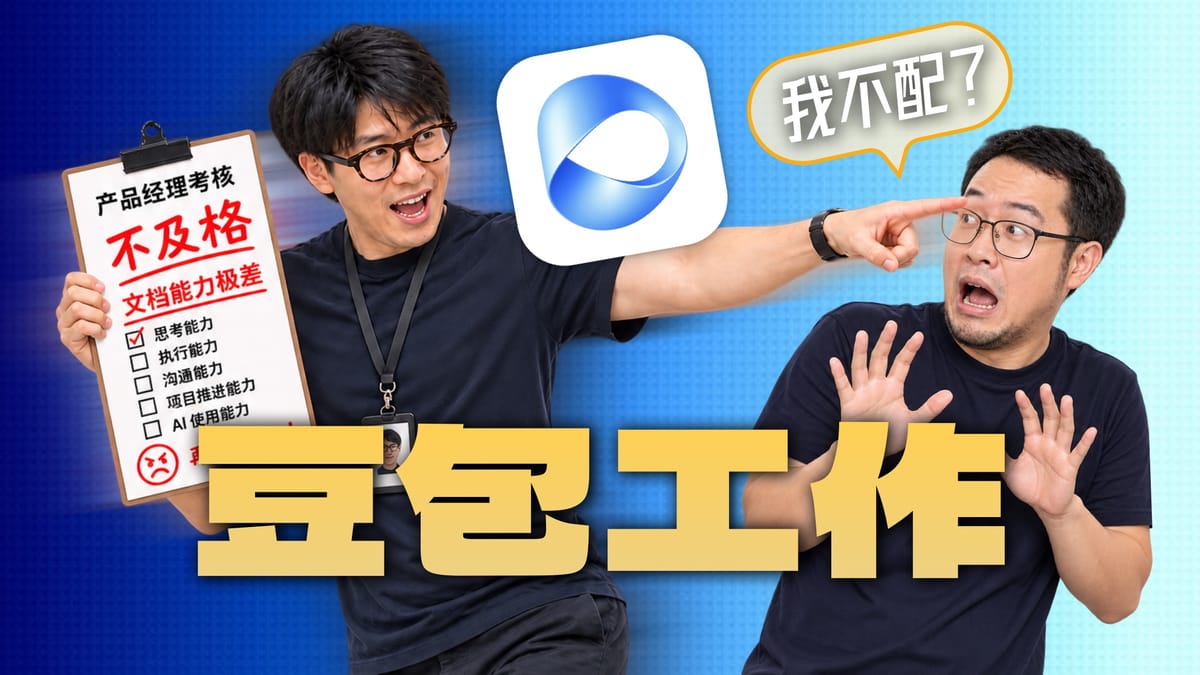
Can Doubao actually work? This soul-searching question has been rattling the tech world lately, and it hit me like a slap in the face. After 15 years in product management, I thought I knew my stuff. But when I handed my 'flawless' specs to Doubao and it doused me with ice-cold reality, I had to admit a brutal truth: it's not about whether Doubao can work — it's that I'm not even worthy of it!
Ever wonder why AI office tools deliver wildly different results for different people? Big tech claims AI can replace junior employees, but when you try it, it seems dumber than a box of rocks. Are the giants fooling us, or is our own business process just a mess?
I Gave It 100-Point Requirements, and AI Hit Me Back with a 10-Point Insult
The other day, I was deep into pair programming, trying to lighten my team's load. Anyone who's done product or tech management knows that product assistants and project managers do the most thankless grunt work. In traditional teams, devs constantly mock them: 'They don't know anything, just nag about deadlines and fetch coffee.' If you tried to enforce rigid specs, people would flip out on the spot.
So why not let Doubao take over? I spent an hour giving it full access to my 'comprehensive' requirements and Kanban board, smugly waiting for praise.
Reality punched me right in the gut! Doubao, like an emotionless examiner, fired back a humiliating score: 10 out of 100!
Its feedback was scathing: 'Typical garbage requirements! Where's the core prototype? Where's the glossary? Did you define state transitions? It's all surface-level fluff! Don't expect me to move forward until this hits the 60-point passing grade!'
I froze, cold sweat running down my back. The half-heartedness human subordinates wouldn't dare voice was laid bare by a machine. In the face of industrial-grade standards, what are our so-called 'workflows' that we've been fudging with office politics?
No Secrets Under the Sun — Don't Mistake Your Style for a Trade Secret
After that blow, I immediately thought of typical boss archetypes. Many bosses, when told about integrating Doubao, Qwen, or WorkBuddy into their business, react defensively: 'Why should I feed my data to Doubao? My trade secrets are worth millions — shouldn't the model pay me for learning my stuff?'
I almost laugh at that. What kind of trade secret is that?
It's like a retail newbie signing a contract with a top ERP vendor — you follow their 20-year playbook for inventory reconciliation and supply chain turnover, and you've got it all figured out in a day. 99% of business logic is publicly available best practices. There's no secret kung fu manual in the real world.
Many bosses think their 'family recipe' is proprietary, but stripped down, it's just 'corporate style.' LLMs have already read the best business practices a thousand times over. Do they really care about your trivial data? They don't lack business knowledge — they just need to figure out whether you prefer 'ship fast' or 'employees first' in your communication style. If you feed AI a messy, version-confused SOP, you get garbage output. Who's to blame?
Wanting a Perfect First Pass with Zero Rework? That's a Baby's Dream
Beyond data paranoia, there's another workplace disease: unrealistic 'one-shot perfection' expectations for AI.
Many people try Doubao once, toss a vague sentence at it, see mediocre output, and sneer: 'See? I told you AI can't do real work!'
Isn't that just being a giant baby? In real life, you send an intern to buy coffee, say 'get a coffee, no ice,' and when they bring back a lukewarm decaf latte, you blow up because you actually wanted an iced Americano with three cubes. If you can't even articulate your own needs, why expect others to read your mind?
Think about it — that 'quiet, reliable, delivers' star employee on your team, did they nail it on the first try? Don't be naive! Any impressive proposal went through seven or eight revisions behind the scenes, countless all-nighters, and maybe even external experts paid out of pocket. If human experts need painful trial and error to deliver, why do you expect AI to ace it with one vague prompt?
Blunt Truth: Burning Tokens on the First Try Is a Necessary Tuition Fee
This brings us to the core question: Why are all the big tech companies suddenly obsessing over AI office tools?
We've discussed a controversial take on our show before, and got slammed for it: Big tech's AI workbenches are essentially designed to force you to burn more tokens!
But today I'm telling you: It's crude but true! In the real battlefield, the first task you run on AI will likely be a dud. But you have to grit your teeth and burn those tokens! If you don't burn the first batch to expose the blind spots, you'll never hit the bullseye on the second.
Long-horizon, multi-step tasks used to be the Achilles' heel of LLMs. With 95% accuracy per step, ten steps would snowball into a mess. But that tipping point has been flattened!
The newly released GPT-6 scored a terrifying 99.9% on ARC-AGI-3, a test of autonomous exploration, while the previous champion, Opus 5, only managed 38%! Domestic tools like Qwen Office, Doubao Work, and WorkBuddy have also crossed the threshold. When I gave Doubao my task, it not only identified the bugs but proactively provided priority-based decision rationale. Within three to five interactions, it can deliver a solid 70-80 point result, and even after a dozen iterations, it doesn't go off track. When the tool has evolved to think and self-correct, are you still going to begrudge the cost of trial and error?
Skip the Fancy Stuff — Record Every Meeting
Since capabilities have crossed the tipping point, how should ordinary companies actually put AI to work?
Many managers immediately talk about spending hundreds of thousands on private models or 'distilling veteran employees.' My advice is down-to-earth: scrap the fancy budget and, starting tomorrow, record audio and video of every kickoff, review, post-mortem, or even criticism session!
Why does bringing AI into work chats turn into a dialogue of the deaf? Because chats are full of 'received,' '1,' orphaned ticket numbers, and emojis — pure garbage context! Feed AI a brain full of junk, and of course it goes crazy!
But meetings are a goldmine! In the conference room, people come prepared. What's the boss's core intent? Which plan got approved on the spot? Who did the boss tear into? All the power dynamics are in the recording.
Use Feishu Minutes to transcribe voice to documents, pair it with Doubao Work to consolidate outputs in Feishu Docs, and give AI full context access. For those who hate writing docs, passive documentation is the only cure. Start recording your daily meetings, and I guarantee agents will find their way into your company!
So back to the original question: Can Doubao actually work? The answer is unequivocally yes! It's even more ruthless and better at holding the line than we are. This office revolution isn't exposing AI's stupidity — it's exposing the sloppiness we've cultivated in the era of 'shoestring operations.' When machines start enforcing standards seriously, what really needs to be rebuilt is our self-satisfied 'experience.'
After being called garbage by Doubao, I quietly closed the window where I was about to chew out my subordinate, and sheepishly opened my docs to fill in the prototypes and processes. Turns out, in this era, the first lesson to avoid obsolescence isn't learning fancy skills — it's swallowing your pride and letting the machine put you in your place.
It's not that AI can't fight — it's that you're not even worthy!
[Subscribe to JustSayAI Daily Brief] 📮JustSayAI Daily Brief · Fan Exclusive Benefits Two emails daily · Listen in one click! Now supports Email + IM + Skill endpoints