Nvidia Just Passed Apple. Here’s Why Jensen Huang Is the Most Worried Man on Earth
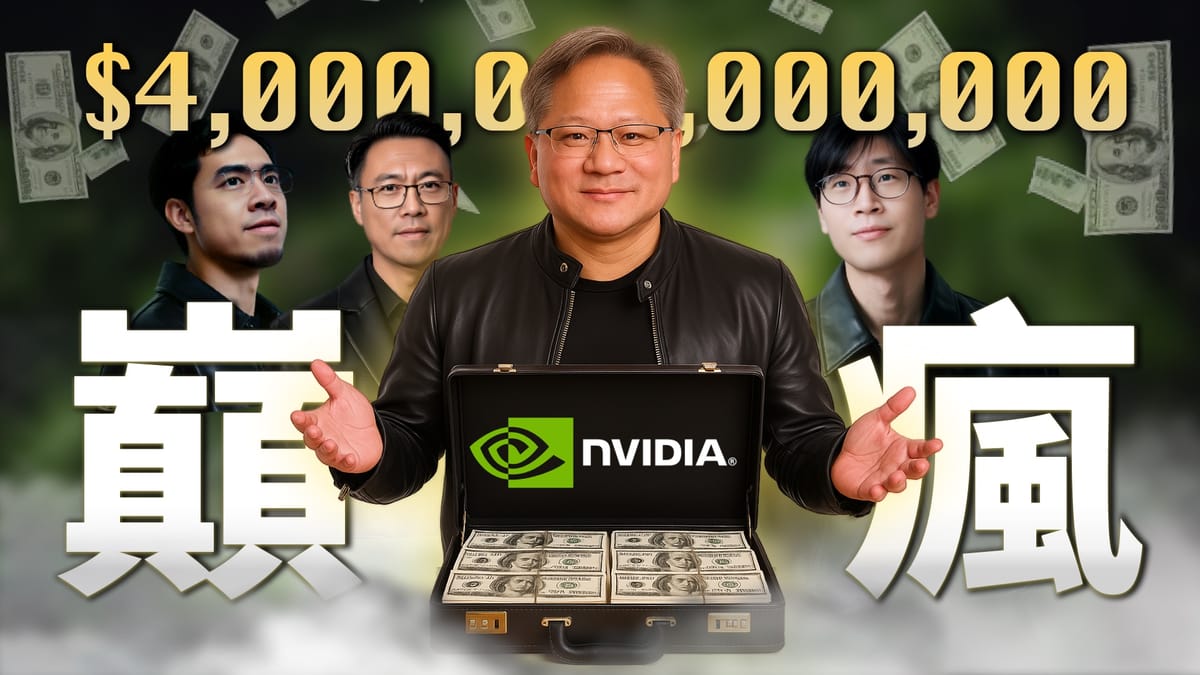
Right now, Jensen Huang is the most anxious person on the planet.
(Update 7/15: Nvidia resumes H20 AI-chip sales to China.)
Don’t let the $4 trillion valuation fool you. The crowd cheering “king of the world” is exactly when the crown starts to feel like a target. Jensen’s real fear isn’t AMD catching up or some tired “scaling-law slowdown” narrative. It’s a deeper law of history: technology always bows to the market—and he is being forced to hand his biggest customer the shovel that will bury him.
CUDA Myth: a 20-year moat dug one compiler at a time
Nvidia’s throne is mortared with CUDA. In 2006 Jensen planted that seed while Wall Street laughed that it was “worth zero.” For five straight years he was called an idiot, the stock collapsed 90 %, and Microsoft and Apple walked away with their orders. He held the line.
That obsession bought a 20-million-developer religion. The killer detail: absolute backward compatibility. Your decade-old gaming card still runs the newest CUDA binaries—and gets faster with every driver drop. It’s not a tech lock-in; it’s a life-support system. Once your code, your career, your startup’s entire existence compile only with NVCC, migrating isn’t a line-item cost—it’s corporate suicide.
“Market can’t buy technology”? Tell that to China
No moat is eternal. When a technology becomes a geopolitical monopoly, a stronger force awakens: low-end disruption.
Which matters more—tech or market? China’s last forty years answer with one playbook: open the market, swap scale for know-how, then out-build the teacher. Cars, trains, telecom—same story. Chips are next. When the 40×-faster Blackwell line is banned, Beijing doesn’t fold; it reroutes fiber for photonic interconnects, clusters mid-tier silicon, and yells “architecture beats transistor” loud enough to spook investors. Jensen, Taiwanese-born, knows the “fight-to-survive” reflex better than any Valley CEO.
Jensen’s clock: can iteration outrun nationalism?
Every public move now smells of self-rescue. Meeting Trump for photo-ops, shuttling to Beijing to slow the exodus—he’s trying to referee a game he never wanted to play. The new gospel of “physical AI” as the next trillion-dollar frontier? That’s not prophecy; it’s a frantic search for a second curve before the first one gets nationalized.
Because once China ships “good-enough” silicon plus a home-grown software stack, CUDA’s gravity well evaporates. User scale inside China dwarfs any other region; domestic apps will optimize for domestic GPUs first. The siege tables turn: Nvidia forced to defend, China on offense, time the decisive variable.
I bet Jensen misses the simpler era when his biggest headache was frame-rate benchmarks. Now the dilemma is existential and can’t be solved with faster transistors.
Asked about retirement, the 60-something CEO jokes he’ll work another 30 years—and when he can’t, his AI avatar will. The ultimate killer app may not be a chip but “CEO-as-a-Service”: a digital Jensen to absorb the political heat while the real one codes in peace.
Technology wins battles; markets win wars.
The highest wall still fears a village siege.
Viewpoints adapted from my podcast: People’s Park Talks AI
👉Subscribe to “JustSayAI Daily Brief” · twice a day · one-click listen: https://justsayai.org/newsletter (VPN required)
【Follow us】:
📺Bilibili: CallMeXiaoSu
📕Xiaohongshu: People’s Park Talks AI
▶️YouTube: People’s Park Talks AI