Tesla’s Robotaxi Just Went Live in Austin. The $1 Trillion War for the Wheel Has Begun
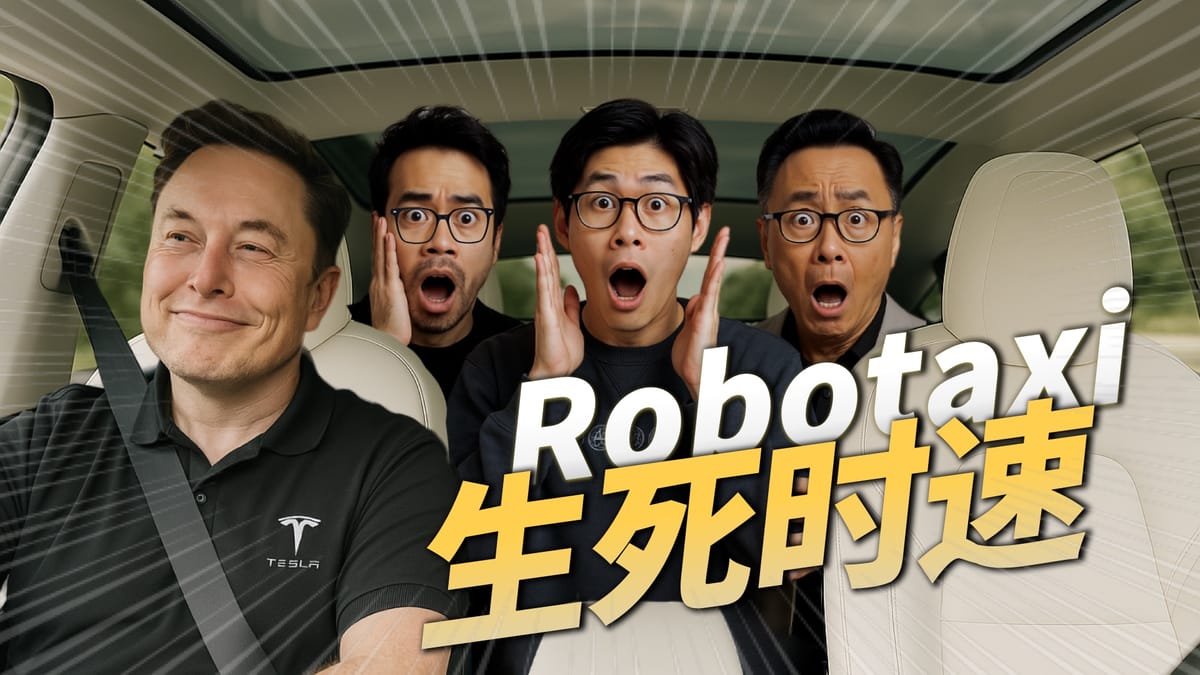
When Tesla’s Robotaxi rolled out in Austin, I didn’t see a feature drop—I saw the first shot of a decade-long, trillion-dollar war. Next to this, SaaS AI demos look like kids playing house. The debut had warts—hello, phantom braking—but the ceiling it showed was enough to make me nod, not nit-pick.
Spare me the lidar-vs-vision theology. Waymo was never going to make money.
We keep framing the AV fight as a sensor slapfest. Wrong. It’s a business-model cage match, a death grapple over cost structure.
Tesla’s “con”: sell cars to conquer mobility
From day one Tesla picked the only path that scales. It isn’t a car company; it’s an AI outfit wearing a car-company skin. The whole business is a flywheel engineered for AI supremacy:
Hardware flywheel: every new Model Y adds another roaming, 24-hour data collector to a fleet already millions strong—something no Robotaxi startup can match.
Data flywheel: Tesla sits on 100-billion real-world kilometers, outgunning Waymo 100× in volume and diversity. Country mud, urban blizzards—this is the end-to-end net’s real training diet.
Cost flywheel: the company off-loaded the priciest asset—the car itself—onto owners, who also pay for charging and maintenance. Waymo buys vehicles; Tesla owners beg to list theirs. This isn’t Didi, it’s Airbnb on wheels.
While Waymo burns cash keeping its own fleet alive, Tesla has built a self-feeding, owner-powered AI empire.
I’ll say it flat: Waymo will never turn a profit. Its route—elite engineers, redundant sensors, centimeter-perfect HD maps—chases absolute safety and achieves absolute unsustainability. You can’t run a commodity taxi service on NASA budgets.
$70–100k per retrofitted Jaguar, versus a few hundred bucks of cameras. Each new city needs fresh HD maps and local babysitting—a cost黑洞 with no bottom. That’s why, ten years in, Waymo is still a zoo exhibit in a handful of towns and a rounding error in Alphabet’s earnings.
Musk’s Achilles heel: born in the U.S., must scale in China
Tesla’s risk isn’t technical—it’s geopolitical. Like Apple, it nails the 0-to-1 disruption in America, then leans on China for 1-to-N scale. Without Shanghai’s gigafactory and supply chain, Tesla’s cost curve and output volume implode.
The catch: you have to keep both Washington and Beijing happy while they square off. Meanwhile, China’s own “new forces”—Nio, Xpeng, Li, Xiaomi—iterate like crazy on user experience and smart cockpits, Tesla’s weak spots, backed by state-level “vehicle-road-cloud” infrastructure Musk can’t tap.
The future of AI rides on wheels, not in the cloud
Autonomy is the first real AI war: physical, data-hungry, cost-sensitive, safety-critical. It exposes every hard truth the software-only crowd has been dodging. Stop day-dreaming about AGI in the sky—look at the tire tracks Tesla, Waymo and the Chinese battalions are carving through real streets. That mud-splattered roadmap is the closest thing we have to an AI endgame.
Dragon-Ball fusion?
Sometimes I fantasize about Musk and Xiaomi’s Lei Jun pulling a Dragon-Ball fusion: Musk’s first-principles lunacy plus Lei’s supply-chain ruthlessness. Unbeatable. Until then, the rest of us will keep feeling for the road by copying Musk’s footprints.
Viewpoints condensed from my podcast: People’s Park Talks AI
👉Subscribe to “JustSayAI Daily Brief” · twice a day · one-click listen: https://justsayai.org/newsletter (VPN required)
【Follow us】:
📺Bilibili: Just call me Xiao Su
📕Xiaohongshu: People’s Park Talks AI
▶️YouTube: People’s Park Talks AI