
Carving Up Intel: From “America’s SOE” to a New NV-tel Axis
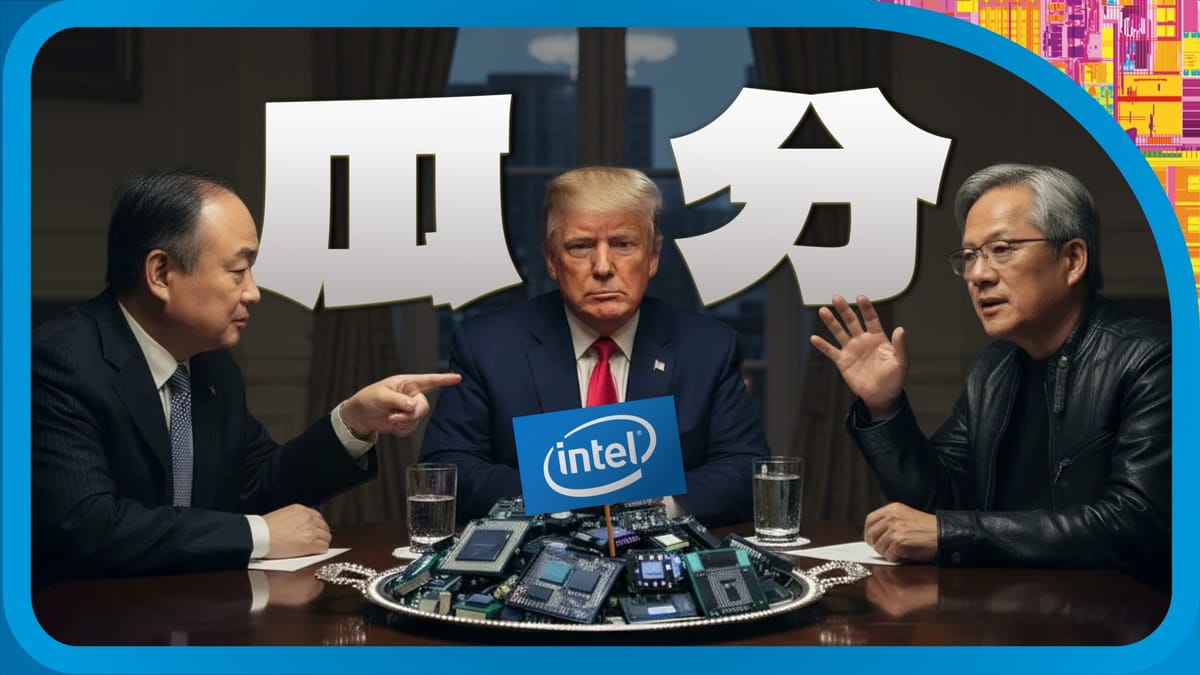
Late update, but the drama is too good to miss.
That Intel bong—bum-bum-bum-bum—you can now unironically call it America’s state-owned enterprise. When the U.S. government becomes the largest shareholder, the game changes completely.
Trump’s Open Conspiracy: America’s “Third Front” Build-Out
Who says Trump wants to “save” Intel? I don’t buy it. The deal-maker-in-chief is just doing math. He’s turning the last administration’s bailout into political capital: “Look, I made taxpayers money—I took equity!” Behind the tweet is raw geopolitics.
Trump doesn’t care whether Intel lives or dies; he cares that advanced silicon manufacturing stays on U.S. soil. Think of it as America’s version of China’s 1960s “Third Front” strategy—stash the industrial crown jewels deep inside friendly borders. Profitability, efficiency, bloat—none of that matters. What matters is that the silicon arsenal is nailed down. Once nationalized, Intel’s mission stops being competition and starts being positioning.
Jensen’s Gambit: Stab AMD, Crown the Next Wintel
If Trump’s move is political, Huang’s is a commercial ambush. The kid who once begged for table scraps now owns a seat. He’s not after dividends; he wants the last thing Intel truly owns—a seat at the CPU table.
x86, the 1970s instruction set that still rules PCs and data centers, is the prize. In the AI era every GPU needs a CPU sidekick—OS, toolchain, enterprise contracts, all bolted to x86. Rather than fight a fading titan, Huang buys a slice and folds the ecosystem into his own. Goal: an AI-era “NV-tel” duke-and-king combo, Wintel 2.0. First casualty: AMD. Once Nvidia and Intel share a cap table, AMD becomes the guy caught in a god-tier crossfire. All that Huawei fear-mongering? Classic “raise the enemy to raise yourself”—the real knife goes into AMD’s ribs.
Son’s Hedge: Two-Architecture Insurance Policy
Masayoshi Son’s 2 % stake is the slickest move of the feast. He already owns ARM—the x86 killer—yet quietly grabs Intel paper. It’s the ultimate straddle: whichever architecture wins, he wins. Twenty billion buys him a geopolitical passport and a tech-ecosystem insurance policy that used to be impossible at any price.
The Estate Sale of a Dying Leviathan
So what did they really buy? Not fabs, not packaging—those are sides. They bought the one asset that can’t be cloned overnight: the x86 moat. Intel’s corpse is being re-sectioned into strategic resources. The episode flips the AI-era rulebook: when tech becomes core to national security, market logic exits and raw statecraft takes the chair.
Picture a crumbling European manor—roof leaks, taxes due, but the chandeliers are still crystal. The mayor (Trump), the neighborhood billionaire (Huang), and the traveling financier (Son) move in. They’re not inheriting titles; they’re looting the vault. Trump carts off the “made in USA” banner. Huang yanks the CPU master key. Son pockets a dual-citizenship badge. The old aristocrat? Still humming its jingle while the furniture disappears.
Bum-bum-bum-bum.
Viewpoints condensed from my podcast: People’s Park Talks AI
👉Subscribe to “JustSayAI Daily Brief” · twice a day · one-click listen: https://justsayai.org/newsletter (VPN required)
👉Join our membership for briefs + deep-dive reports + columns: https://www.youtube.com/@justsayaiorg/join
【Follow us】
📺Bilibili: CallMeXiaoSu
📕Xiaohongshu: People’s Park Talks AI
▶️YouTube: People’s Park Talks AI