The 2025 Food-Delivery Knife Fight: Why China’s Giants Would Rather Subsidize Fried Rice Than Bet on AGI
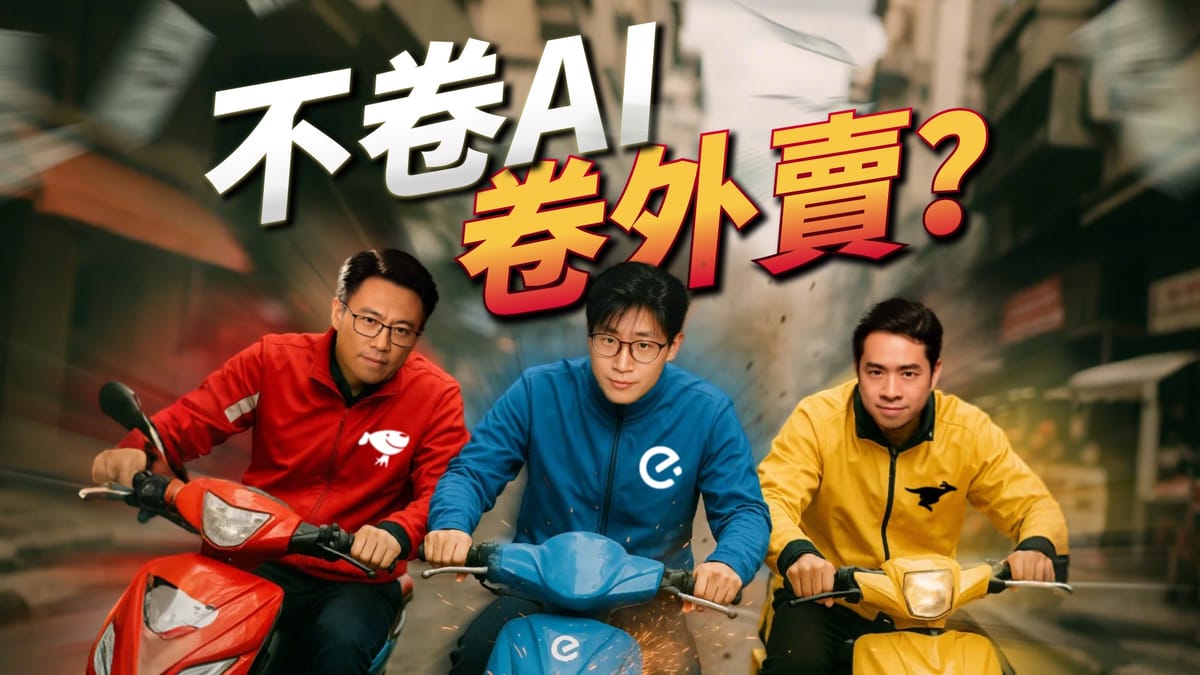
Alibaba can’t lose. Taobao funnels the traffic, Ele.me takes the order, Taobao sells the ad slot, then red-envelopes the cash back—an infinite arbitrage loop.
In January they were “All-in AI”; by June they’re “All-in take-out.” While WAIC—China’s world AI jamboree—spent last week genuflecting to LLMs, AGI and humanoid robots, the country’s internet oligarchs outside the venue quietly signed up for the oldest, bloodiest ground game on earth: food-delivery subsidies.
We’ve done both “All-in”s ourselves, so here’s the short verdict: AI is AI; lunch is lunch. The U.S. bets on AI for growth; China raids the same fridge for share. My takeaway from the last decade: if you try to sell cabbage with rocket science, you die.
This isn’t business; it’s corporate therapy. The giants can’t lose—only the merchants bleed. I still don’t see the point of siphoning dine-in customers onto a platform; total retail spend doesn’t budge. You just get the data and the throne.
Burning cash isn’t for AI—it’s for coronation
Plenty has been said about e-commerce and food apps eating each other’s turf. Here are three fresher lenses.
First, dissect the prime mover: Alibaba. Brutal truth—Alibaba doesn’t need this war. So why march, and so ferociously? Answer: org chart, not roadmap.
With Ele.me and Fliggy folded into “Greater Taobao,” new commander-in-chief Jiang Fan needs a signature victory—Zhang Yong had Singles’ Day; Jiang gets a shooting war. Nothing rallies troops and locks in political capital faster than an external enemy.
The playbook is grotesque: use mid-frequency “Taobao Flash Shopping” to siphon high-frequency traffic from Ele.me, shuffle orders and data inside the same family, and inflate Taobao daily-active numbers. It’s a calculated civil war that bleeds rivals’ cash while cementing internal power. Alibaba has the deepest pockets; a war of attrition starves Meituan just as its second-curve bets are still loss-making.
Do the math—Alibaba already did.
JD plays open hand; Meituan fights with its back to the river
JD is the guy who flips the table. Richard Liu, a street-fighter from the warehouse floor, knows exactly where to punch. For JD this is all upside—zero cannibalization. They start with highest-margin SKUs (coffee & milk tea) to ramp volume and noise.
In my experience every JD “new business” serves one verb: recycle. The company is asset-heavy—logistics, warehouses, delivery fleets—so the existential question is how to keep those fixed assets spinning. Food delivery, community groceries—just the latest SKU on the same conveyor belt. The real goal: become China’s largest wholesaler with last-mile reach. Smart, but convoluted.
Meituan is the tragic hero. Delivery is its Maginot Line, now assaulted from every side. Irony: JD has no second curve; Alibaba has cash and a second curve; Meituan’s second curve is still cash-hungry. It must defend a shrinking moat with its own profits. Wang Xing’s mantra—“long-term and patient”—has never been stress-tested like this.
Retail’s impossible triangle: traffic, fulfillment, payment—pick one to burn
In China today no one owns all three vertices. WeChat & Douyin hoard traffic but can’t fulfill; Alibaba, JD, Meituan massacre each other in fulfillment; WeChat Pay & Alipay own the rails. When giants realize funneling ad budgets into Douyin is less efficient than turning ad dollars straight into user coupons, the subsidy logic clicks: burn the vertex you’re missing—traffic—and watch the spreadsheet ignite.
Stop the nonsense—cabbage data won’t train god-tier models
Does any of this feed AGI? Zero.
Dispatch and route optimization are 2015 tech; they don’t need 2025 LLMs. Low-ticket, one-dimensional transaction logs are worthless for frontier models. Social and grocery data sit at the bottom of the data barrel. We learned the hard way: high tech selling produce is a death sentence. You can’t pay Silicon-Valley salaries to support retail margins thinner than spring-onion peels. In a 30-RMB order there’s simply no room left for AI fairy dust—not even a scallion.
Star-gazing while wading through sewage
Strip away the “AI-powered retail” fairy tales and you see raw anxiety: a high-certainty, low-imagination turf war. This isn’t building the future—it’s partitioning the present. Giants prefer hand-to-hand combat for pennies today over an uncertain AI jackpot tomorrow.
Veterans of the 2015 subsidy bloodbath watch 2025 with déjà vu. Onstage: “starry sea of AGI.” Offstage: street corners fought over a 3-RMB coupon. Surreal doesn’t cover it.
AI is poetry and distant galaxies; food delivery is mud and bayonets.
Viewpoints from my podcast: People’s Park Talks AI
👉Subscribe to “JustSayAI Daily Brief” · twice daily · one-click listen: https://justsayai.org/newsletter (VPN required)
【Follow us】:
📺Bilibili: Just call me Xiao Su
📕Xiaohongshu: People’s Park Talks AI
▶️YouTube: People’s Park Talks AI